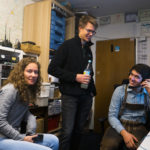
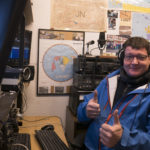
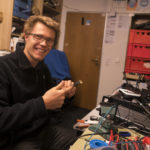
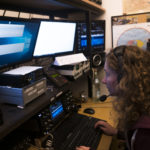
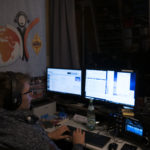
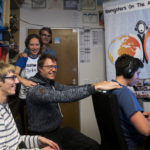
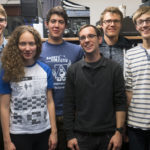
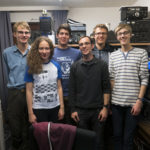
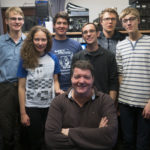
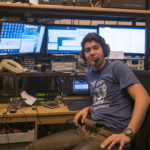
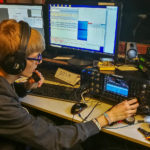
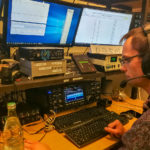
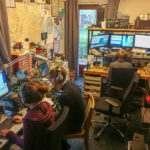
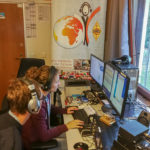
Train the Trainer Report – Team Algeria – December 2018

By | Train the trainer | No Comments

Our projects for the next 2 months

  •  Organization of a conference on amateur radio activity within a university and (Ecole Polytechnique)
  • –  Demonstration on site with radio equipment.
  • –  Radio demonstration for Scout group leaders (aged 22-25) followed by a PowerPoint presentation


Projects 2019 (6 to 12 months)

  • –  Assembly of transmitters for ARDF practical training for young academics
  • –  Conferences within universities and high schools
  • –  Import of kits (UBTX) organization of several sessions practical work for

    the assembly of these kits

  • –  Participation in the JOTA jamboree on the air as every year
  • –  Organization of a field day for young YOTA people

    (the event will take place in a forest or mountain)

  • –  Organisation of one or two ARDF competitions
  • –  Organisation of IOTA with YOTA people


Our YOTA activities (2018) can be summarized as follows:

  •  –  January : Activity on the 160m band at the top of a hill next to a basilica Organization of a field day in East Algiers
  •  –  March : Training at the radio club of the South 7X3WPL theoretical and practical training AMSAT
  • –  April : Demonstration and basic training day for young, young Scouts of early age
    Conference on amateur radio activity in collaboration with
    an electronic club in a university with a demonstration for young students
  •   May : Simulation of emergency communication with young people in a forest in Algiers
  • –  July : Participation in the festivities of the Independence and Youth Day in East Algiers especially for young people. Organisation of an IOTA expedition in the West of Algiers with a group of young people (aged 20-33)
  • –  August :  Participation in the Arab Scout Camp demonstration
    in VHF SSTV . 
    Explanation on the radio activity given to young Scouts from several Arab countries
  • –  October : Participation in JOTI JOTA 61st edition, a training course
    was organised + a mock exam at the end.


Problems we face in getting more youngsters into amateur radio

No particular difficulties.

December YOTA Month – Bulletin 2018

By | Publication, YOTA Month 2018 | No Comments

December is getting closer and closer … and what does this mean for us?
It‘s time for some great activity on the bands in the upcoming DYM 2018!

But it’s not a good event without some rules, attached to this post you can find the official bulletin of 2018.

All participating stations will receive the PDF via the registered mail address as well.

This bulletin contains information like …

  • Overall rules for the event
  • Log system for approved callsigns
  • Station profiles on the DYM website
  • How to handle qrz.com pages
  • QSL policy
  • Hamyota on social media
  • FAQs
  • Funding
  • Newly implemented award system
  • General contact information

But the most important thing during the event … have fun and bring the youngsters on the radio!

Because we know that there is YOUTH in hamradio!


You can find the PDF here …

DYM_2018_Bulletin

Youth Contesting Program 2018 – DQ5M (@DM9EE)

By | Community Written, Publication, Youth Contesting Program | No Comments

After seeing posts about the YCP at DM9EE I immediately applied, eager to be able to take part in
the CQWW SSB contest from a big contest station. My contest experience was limited, having only
participated at smaller stations and once at 9A1A as part of the YCP program. I was eager to gain
experience and learn more about contest techniques and strategies.
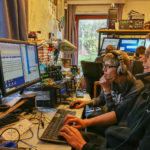
Six youngsters were selected to go to DM9EE for the contest, 4 of them coming from various
regions of Germany, one from Sweden and myself from Austria. It was an interesting combination
of people, with different skill levels, some having only operated QRP stations whilst others had
been to large contest stations before.
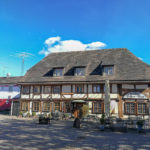
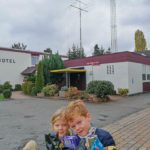
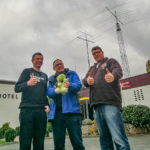
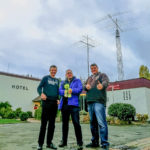
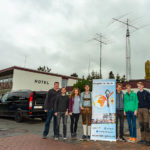
On Friday we arrived at the DX-Hotel in Holzminden in the north of Germany owned by Carsten
Dauer, DM9EE. The DX-Hotel (see dm9ee.de for more information) is a normal hotel, only that in
the garden there are two high masts with yagi antennas on top and a 4 square for the 80 meter
band. The station itself consisted of two IC-7851 transceivers with an OM-Power and an ACOM
amplifier. One thing some of us had never seen before was the micro ham system which connects
all parts of the station. The functionality it provided was impressive, however before we could get
started some tweaking was required so we got right to work to make sure everything was working
flawlessly. Thankfully we arrived early before contest begin so we had enough time. At the last
minute we had to solder a new control cable for one of the amplifiers as we changed the set up a
little to optimise the station.
The antenna systems were great, an opti beam ob-17-4 (3 element on 40m, 4ele on 20m, 4ele on
15m and 6ele on 10m), a 4 square for 80 meters and an inverted L wire antenna for 160 meters. All
of this concealed in the garden of the hotel. A big thank you to Carsten, DM9EE who not only
provided the station and his experience but also housed us in his luxurious hotel. I am sure no
other contest team lived and ate as well as we did during the contest.
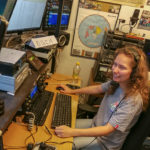
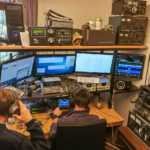
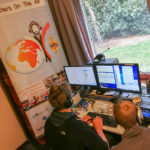
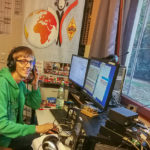
We operated using the call DQ5M, a special youth contesting callsign. During the contest we
changed operators approximately every 3 hours, however sometimes we operated for 4 or 5 hours
and other times we changed more frequently. There was no tight schedule, if an operator wanted
to be replaced, one of us would jump at the opportunity to operate again. The contest itself was
very interesting, we had never seen the bands so extremely full. It was an interesting experience
and a challenge to call on a frequency when you can hear and even understand the station above
and below you. We quickly noticed that we were able to achieve better rates using search and
pounce, especially for multipliers. Towards the end of the contest we had to resort to calling on a
frequency as we had already worked all stations which we were able to hear on the band, the band
map became very empty. Occasionally a new multiplier would pop up in he cluster and we would
immediately try to work it before resuming to calling.
The social aspect of this event can not be overlooked, new friendships were made and we all
share an enthusiasm for youth work and will work together to spread our hobby among young
people in the future. I have noticed that one of the key factors which makes it difficult to get new
youngsters into the hobby is that there is a lack of other people their age who they can practice the
hobby with, then they quickly loose interest and become inactive. Small events like the YCP events
are perfect to change this. Even though there are quite a few youngsters in Austria, they do not
know each other, they have to be connected at events such as this one. Furthermore a weekend
activity together is the perfect opportunity to get to know each other, the team which met at DQ5M
will stay connected and work together in youth work. Amateur radio needs more events like these
to grow and to pass the hobby on to the next generation.

73 de Monty, OE3VVU
DQ5M YCP team


Train the Trainer report – Estonia – October 2018

By | Train the trainer | No Comments

Train the Trainer

I believe that getting young people attracted to ham radio is quite a challenge in every single country. It is not that kids don’t like to experiment with new things, it’s just that Estonia overall is extremely IT oriented. It all started in late 90ies with government funded projects. The aim was to have special computer classes in every single school. That of course led to special computer classes that gave overall introduction to computers, software, programming etc. As it has been growing over the years it has been now adapted as mandatory class in every single school. So basically what we are creating is a lot of software developers from early ages. And this is something that kids actually like. Now the big question is how to take those enthusiasts and introduce them to ham radio?

What comes to licensing in Estonia it is quite simple and easy. We do have 3 different possible license classes from Rookie to Expert.  Rookie class requires an easy exam with basic questions about ham radio, radio waves etc. We do not have any age limit, so basically even a preschool kid can have a license. Of course at first everything will be supervised and making a first QSO is also taught by an elder. Those who like it, usually keep going and growing into it. But those who like IT technologies more, they just eventually stick to software developing.

At this very moment we have approximately 4 schools with possibility to experiment with ham radio. 2 of them in capital city Tallinn, 1 in Tartu and one in southern region. Not only making QSOs and pure contesting, they teach soldering, making receivers, antennas etc. So there is some sort of youth work going on, but it is the lack of children. If you can choose from creating phone apps or talking to old people over the radio, most would choose the first.

We also have an agreement with ES5TV (ES9C station), that whenever all youngsters are always welcome to use his station. We are participating in JOTA projects. We constantly invite them to major contest, also YOTA coordinated events such as ARI contest, which brings some foreign youngsters here. So long story short, we do have something, not everything. We have schools and superstations to use, we just don’t have children. And this is the biggest problem we face right now. Because licensing is easy, we have no age limit, we have stations from where we could work. We just don’t have ideas how to get more youngsters to join.

ES7GM

Train the Trainer report – Bulgaria – October 2018

By | Train the trainer | No Comments

There were 2 unlicensed people on YOTA from bulgarian team, Angelika and Vanesa. Angelika and more 6 people went to the courses we did for ham radio and from 8 people 7 were licensed. Vanesa did harec examination on YOTA and got the best ham radio class in our country ! Angelika’s callsign is – LZ1ANQ, Vanesa’s callsign is – LZ1BR

We made QSL cards same like the posters and they were given to people in schools and universities.

( 2 in months )
We plan to make more advertisement projects which are completely free, like visiting schools and making presentation about ham radio on physics classes.

( 6-12 )
Our idea is to continue ham radio courses and keep them on every season ( that is the idea for now ). For example – Summer ( course starts 03.06 – 25.06 ends ) and like this every season, and courses will be matched will exams soon after they end.

Train the Trainer report – Hungary – October 2018

By | Train the trainer | One Comment

Hungary Youth Activities

In the last 2 months since YOTA South Africa, we have primarily been working on the environment for successful youth license exams and we held preparing sessions in our society’s HQ.

There have already been ongoing discussions with the national authorities on more favourable conditions for beginners, as well as focusing on our society’s new leadership’s youth policies. We composed a 12-14 pages concise curriculum with a focus on operating skills and safety technics. It is fully coordinated with Media Authorities, therefore it could have been adopted as a full beginner license.

The new license consists of all HF bands, with at least 100 watts. It is also a recent achievement, adding adequate power levels to each license.

Most of the interested youngsters could not take the exams because of its difficulty yet, many have been rejected so it was a serious issue. Now, this October after a long weekend of preparations, on Monday 9 youngsters took the new beginner-level exam, 3 of them also sat a Morse Code exam. We expect this trend to continue.

Now we are putting together the team for the next December YOTA Month, activating 2 callsigns this year as well; HA6YOTA for experienced and HG0YOTA for supervised kids, with or without personal callsigns.

We are planning youth meetings during the winter holiday, at least 1 to operate together at a bigger station, possibly HG6N and improve the youngster’s skills. Members of this club have greatly contributed to youth activities, among some others.

There are some issues to care about yet, like keeping the youngsters active, and connected even if they live in rural areas all around in the country. December will be a good opportunity for this, as well as a possible countrywide or even regional YOTA camp. More work to come here, and we are finally reaching to a point, where we can see actual numbers.

73 de HA8RT

Train the Trainer report – Belgium – October 2018

By | Train the trainer | No Comments

Since the 2018 YOTA Winter Camp in Johannesburg, South Africa, several initiatives have taken place in Belgium. We’d like to think this is because of the inspiration we gathered from hanging out with HAM’s our age and hearing each other’s ideas.

The greatest success story is that Ben ON6FBR and Ward ON8WR were received by the board of the national radio league of Belgium, the UBA (Royal Belgian Amateur Radio Union). We discussed what we did in South Africa and shared our ideas of what needed to be done to lift youth participation in Belgium to a higher level. Our words were well received, as the UBA responded that they are open to all ideas considering youth participation and will discuss all propositions in order provide funds to carry out these ideas.

During the R1 UHF and up contest, the OT5A team – operating as OT5A/P – involved HAM radio operators as young as 13 years old. Almost half the contest team was younger than 30 and was very active on the radio. This involvement showed that age doesn’t matter and may even be a benefit to the operations. Especially during buildup, the help of 20-year old HAMs is appreciated among the more “experienced” operators.

One of the more ambitious projects that have started is “De Shack”, a makerspace in Sint-Laureins in the west of Flanders, the Dutch speaking part of Belgium. This non-profit organization was formed by Tommy ON2TD with the aim to provide a workshop environment for all technology-curious people to come and work on their projects. There is a strong link with HAM radio, although this is not immediately obvious. As the project-building workshop at the YOTA camp showed, HAM radio is about so much more than just making QSO’s and contesting. “De Shack” tries to replicate this concept by organizing sessions teaching things such as making your own Bluetooth speaker, or a Halloween evening. There are frequent open sessions as well where you are welcome to drop in and work on your own projects. It is the hope of the organizing team that these youngsters will once find their way into HAM radio, and that it is wrong to bombardment them with radio technology from day one. It should be a gradual process, driven by a natural curiosity.

Meanwhile there are talks of organizing a camp next year for youngsters during the summer holiday at the Euro Space Center, linking the science and technology aspect of space and all its mysteries with HAM radio. A precise plan doesn’t exist yet, but it will certainly mimic aspects of the YOTA camp such as workshops to build things, site visits, cultural activities, combined with an on-site hotel and shared meals. It goes without saying that a 24/7 radio station will be available.

Belgium will also participate in the December YOTA month, the callsign ON4YOTA has been received and registration is open to have as many youngsters possible use the callsign. We’re certain this will again be a great success.

We also found out a new Telecommunication Law is being written in Belgium, that will make it easier to let people without a license operate a transceiver for events that aim to promote ham radio, and drop the age to get a callsign to 12 years (now you have to be 13 years old).

Our next big (youth) recruitment event that is coming up is FOSDEM. At FOSDEM, Kristoff ON1ARF, together with several Belgian radio clubs, puts up a portable HF station with next to it a 25m mobile antenna mast, and a lot of toys (SDR sticks, APRS beacon, satellite tracking equipment, …). FOSDEM (Free and Open-Source Developers European Meeting) is an event where over 5000 open-source software (and more and more also open-source hardware) developers from all over the world meet in real life. Last couple of years the interest in Software defined radio also got a big boost by GNUradio. Tons of people are using GNUradio every day to listen to all kind of transmissions and decode them, but a lot of them are not aware that as a ham they can transmit on a lot of bands as well. Most of them only know about CB-like operations on HF but don’t have a clue about the UHF / SHF bands we can use, about digimodes, APRS, digital voice on HF, satellites, ….

We always get a lot of very interested people over from all over the world, and try to direct them to a local ham radio club or to their national ham radio organization. Most visitors are over 18, but still a lot younger as the average HAM age.

Meanwhile Ben and Ward are involved in the organization of a hackercamp for families in Belgium and will continue to promote HAM radio directly to this audience with a portable shack, similar to the FOSDEM initiative of Kristoff. The next edition will take place in 2020.

This concludes our report of the YOTA activities in Belgium that have started since the 2018 YOTA camp in South Africa. We truly believe in a diverse approach, since there is a larger risk of failing and less outreach by organizing one single initiative. Thank you!


Train the Trainer report – Lithuania – October 2018

By | Train the trainer | No Comments

ACTIVITIES SINCE YOTA 2018

  • On 14th of October, 2018 a on site competition called “Prof. A. Jurskio memorialas – 2018“
    organized by the Kaunas University of Technology radio club for youngsters of several age
    groups took place in Kaunas, testing youngsters knowledge, ability to assemble a kit, SWL
    contest, ARDF contest, VHF contest all in one event. Over 10 youngsters participated and
    competed against each other, winning prizes and gaining experience. One of the camp
    participants Linas LY5BT has assisted in organizing the event, building connections with the
    participants and organizers.
  •  Participant of YOTA 2018 Haroldas Lapinskas, who got his exam done in ZS was licenced in
    Lithuania as LY5IM. Haroldas is now actively working together with a local science-themed
    entertainment show “Mokslo sriuba” and Vilnius university radio club in order to launch their own
    amateur radio high-altitude balloon experiment.
  •  Barbora LY1KB, who attended YOTA camp in 2017 is actively working towards integrating the
    hobby into the Scouting community in Lithuania. She has made a cartoon educational video for
    scouts about our hobby. The video will also be released in English.
  •  Simas LY3EU has built a 2m APRS digipeater/iGate in his area to extend practically non-existent
    APRS coverage in Lithuania.
  •  A public presentation about YOTA 2018 was done at the Lithuanian Amateur radio society and
    streamed live on facebook.
  •  https://armanual.netlify.com/ – online Amateur Radio manual in Lithuanian and English is was
    opened for public, released by Domantas LY1JA


PLANS FOR NEXT 2 MONTHS

  1.  21st October 2018 – JOTA-JOTI Scouting event. 80m-10m HF station will be active;
  2. Release of educational cartoon about Amateur Radio.
  3.  Further work towards LY high altitude amateur radio balloon experiment.
  4. Youngsters only operation in CQWW SSB contest (station and participants not clear yet)

LONG-TERM PLANS

  1. Further improvements on Amateur Radio manual site to make it international guide to amateur
    radio
  2.  Lihuanian amateur radio society youth committee expansion, participation in amateur radio
    related activities.
  3. Design of memorable apparel and stickers to give exposure to amateur radio and the hobbyists
    themselves.
  4.  Connecting Lithuanian amateur clubs into one single network: having synchronised calendar of
    upcoming activities, creating a discussion thread online, hosting all-club summit.

Links

Train the Trainer report – Northern Ireland – October 2018

By | Train the trainer | No Comments

ACTIVITIES SINCE YOTA 2018
I participated in providing communications for a large triathlon in Northern Ireland in a town called Derrygonnelly. Over 400 people attended the event to take part, including some young people. As the participants ran, cycled and canoed their way along the course, they were met at each checkpoint by an amateur radio operator, who relayed the race leader and any other information back to the control base station which was then relayed to the event organiser. There were many questions asked about what we were doing, and how we were proving communications using our radios, some young people were at the event and had asked me what exactly I was doing so I explained the basics of amateur radio to them to help spread the word about the hobby to the youth. The British Red cross also participated in the event, which I explained in depth how amateur radio worked and all the different opportunities in the hobby, such as being sent away to South Africa for a summer camp to learn more about the hobby and how to promote it. I also wrote the RSGB daily blog posts as soon as I returned from South Africa, which took a lot of time as I was also trying to sort out my university options at the time, and pressure was on from both sides to meet deadlines. Nevertheless, both worked out well. These blog posts were recently adapted by Peter, to shorten them down to a format where they would be suitable for publication in our UK magazine, RADCOM. I was the lead author in the magazine article as the material was originally in the blog posts, just condensed down a little bit to meet page requirements. The magazine has been published and will be on the way to the doorsteps of RSGB members in both the UK and abroad. I also singlehandedly wrote a magazine article for IRTS, Irish Radio Transmitters Society, in which I outlined and told my adventure of travelling to South Africa, as well as spreading the word about all the activities we completed while we were over there. This article proved very successful and got a good response from the amateur radio operators in the Republic of Ireland.

PLANS IN NEXT TWO MONTHS
In my radio calendar, I have an upcoming presentation which I will be delivering to one of the bigger clubs in Northern Ireland, Lough Erne Amateur Radio Club (LEARC) on my experience as part of the YOTA 2018 team for the UK, mainly representing Northern Ireland. This talk will be delivered shortly (9th November 2018) and I am preparing a PowerPoint Presentation full of pictures and information of our activities, but this is still in the design stages. I have also started my further education and hope to inspire others in my class to join amateur radio and make it more well known in Northern Ireland.

LONG TERM PLANS
As well as my presentation to LEARC, I am also delivering a talk to the biggest radio club in Northern Ireland, Mid Ulster Amateur Radio Club (MUARC). This talk will take place in early February and will use the same PowerPoint presentation mentioned earlier, but with any additions I feel necessary and any improvements I feel I can make to my presentation to make it more fun and engaging. This radio club has a larger proportion of younger people in the audience, so it should be an excellent opportunity to inspire some of the younger people to get active in the hobby. I have also provisionally filled out a Registered Assessor Form, and I will consult my club to get a final opinion as to whether I should send the form to the RSGB, so I can then supervise and help with the practical assessments that the club runs occasionally and also teach the exam theory to new candidates who wish to get their radio license. This will hopefully come in useful in my education environment since I will be surrounded with young adults who are interested in electronics/engineering and are ideal candidates for wanting to learn more about the hobby and hopefully completing an exam to gain their license.

DOCUMENTS
As mentioned previously, I am currently working on the PowerPoint presentation for my two talks, so it cannot be added to this document for release just yet.

OFFICIAL SOCIAL MEDIA PAGES
The blog posts I wrote can be found at the following link, by scrolling down to the bottom and selecting which day you wish to read about.
https://rsgb.org/main/about-us/yota/yota-2018/
You can keep up to date with my local club, LEARC, by using the following link. I have now been enrolled as a committee member in the club, and I am the youngest to take up this role in the club’s history. I am excited to share my ideas with the club, and hopefully let it grow and expand, picking up new younger members along the way.
I also manage this website, so check back regularly for updates. At the moment the main notice is my talk which will take place at the next monthly meeting.
https://learc.eu/

Nathan Prentice
MI0NPR
2018 UK YOTA Team Member