How to start a career in telecommunications

By | YOTA Estonia 2013 | No Comments

We worked in teams for this workshop.  This was great fun and everyone had their input.

Everyone agreed that the number one requirement is that the person has to have an interest in the sector.  With this personal interest, one avenue to their career in telecommunications is through education (school, university) where a formal degree, diploma, masters etc is essential to entering or progressing in this area, although in some cases, it is possible to enter the area at a low-entry position and gain a practical experience as you progress through the company/business, but at some point a formal degree will be required for progression.

If studying the theory of your chosen area, then working in the sector at the same time whilst gaining some practical experience may give you a better understanding of your coursework.  Connections to your area of interest (engineering, physics, electronics) can be of great help also, especially in the amateur radio hobby where portions of the HAREC exam concentrates on electronics for example.

Community is essential.  This can be in the forms of local clubs or groups, which can not only to help you personally but also give you their knowledge, offer their assistance in practical terms, have a mentor type relationship, offer a social scene or provide social interaction (maybe in the form of forums, Facebook pages etc).

As a result of your hobby eg amateur radio, this may be the reason for you to follow a career in telecommunications.  Through this hobby, you can build up a network of support. Fellow enthusiasts may be able to assist you get work in a particular area eg if you have a friend or colleague working in a company, and they require the assistance of a professional in some aspect of their business, a colleague may be able to suggest your skills as being suitable to assist, and this could potentially result in a part time position within that company, or even better, a permanent employment opportunity.

Self employment –v- employment with a company:-  although self employment does have benefits in terms of your own independence and working at your own pace, it also requires a lot of start up capital which could have a major loss if the business fails.  It also requires a base clientele which may be difficult to get if there are no prior connections or networks.  It is could be simpler to begin in an employee role to gain the experience you need although this also has draw backs in that you are working to someone else’s timetable and agenda.

All in all, there are a number of avenues to gain entry to the telecommunications industry, which one suits you?

[wpgallery3 AlbumId=1430]

Building Robots

By | YOTA Estonia 2013 | No Comments

This was a brilliant workshop.  It involved pairs of youngsters programming a little robot, which were are cool little buggy type cars with sensors etc, which everyone loved, they were going back and forth, turning 360 degrees etc.  Our two tutors, Ramon and Heilo, taught us how to use the programming commands and how to apply these to the little robots.  We were laughing so much as our robots moved, but not in the way we had thought we programmed them.

We were told “robot always does what YOU program it to do, not what YOU want it to do!” and that “90% of mistakes comes with the WRONG starting position!”.

This applied to all of us at the beginning, we had rogue robots doing what they wanted all over the floor! Our challenge was to make the robots follow the path set out by Ramon, and we had to try not to knock down any plastic trees, or any polar bears and penguins (plastic figures that crashed our party) and this was difficult enough as all the twists and turns made the programming frustrating but funny.

I don’t think one robot managed to make it all the way to the end!  But we had a great time trying to do so, and Ramon and Heilo gave us the robots to play with until the end of the week!  You could find the computer lovers in that room at any time as they dismantled and rebuilt the robots as much as they liked.  A really brilliant workshop!

[wpgallery3 AlbumId=1425]

Kit Building

By | YOTA Estonia 2013 | No Comments

Another great success workshop, it involved getting little electronic kits and building them.  This was done with the help of Juri and Ger EI4GXB.

The kits ranged in difficulty, from beginners to the more advanced, and the end result varied from steam engine sounds to stroboscopes to polarity checkers.  A lot of the kids have never held a soldering iron before and by the time they were finished practising, they were pros!

The kits themselves consisted of little components (resistors, capacitors, LED, transistors etc) which have to be placed on the circuit board and soldered into place.  Once everything was soldered together, the attaching of a 9v battery allowed the circuit to be tested, and more often than not these circuits needed to be fixed, which involved de-soldering (another learned skill) and fixed again.  This was fabulous and a great fun way to learn some new technical skills and the kids spent hours on these, even using their free time to finish their projects which they could take home.

The kits can be purchased on the internet or at your nearest electronic stores anywhere from €5 upwards.  A great little buy for the budding electronic enthusiast.

[wpgallery3 AlbumId=1468]

Energiser games

By | YOTA Estonia 2013 | No Comments

Before all workshops (usually in the morning and afternoon) we had energiser games.  These were set out by the host country (Estonia) with volunteered games from other teams including Finland, Croatia, Romania to name a few.  These games were usually very silly but great fun.  The purpose of the games was to get all participants involved, to feel at ease and to get to know the other teams or individuals.  Essentially they were for “ice-breaking” between people and to break away the shyness or awkwardness that is there when you meet new people for the first time.  Some of these energiser games made us laugh so much, and the silly actions made us look highly amusing.  The games had names like “Funky Chicken”, “Are you busy, Joe?” etc etc.  We also had a game where we were in a human knot, where we had to touch the leg of the persons near us until we fell, where we threw little balls one after the other in sequence until they dropped and so on.  Again, it was great fun and absolutely hilarious.

[wpgallery3 AlbumId=1612]

Intercultural evening

By | YOTA Estonia 2013 | No Comments

Every year in YOTA, an intercultural evening is held at the beginning of the week.

This is where each team bring some food, drink or delicacies from their home countries set up on tables in a big room, each country presenting their items and allowing other members sample them.  They also dress up their tables with flags, balloons, hats, necklaces etc making it look like a United Nations meeting!

Each team takes the floor and tells everyone what they have brought, and explains where it has come from in their country.

This evening is the best evening of YOTA as it allows everyone to mingle, to expand their taste buds and try a little of each new items.  It also allows people to get to know each other, and to swap QSL cards, flags, memorabilia, all of which shows the true spirit of the week – making new friends with similar interests from all sorts of backgrounds.  The buzz in the room at this event is spectacular and there is nothing like it.  A great evening and possibly the best of the week!

Introduction workshop

By | YOTA Estonia 2013 | No Comments

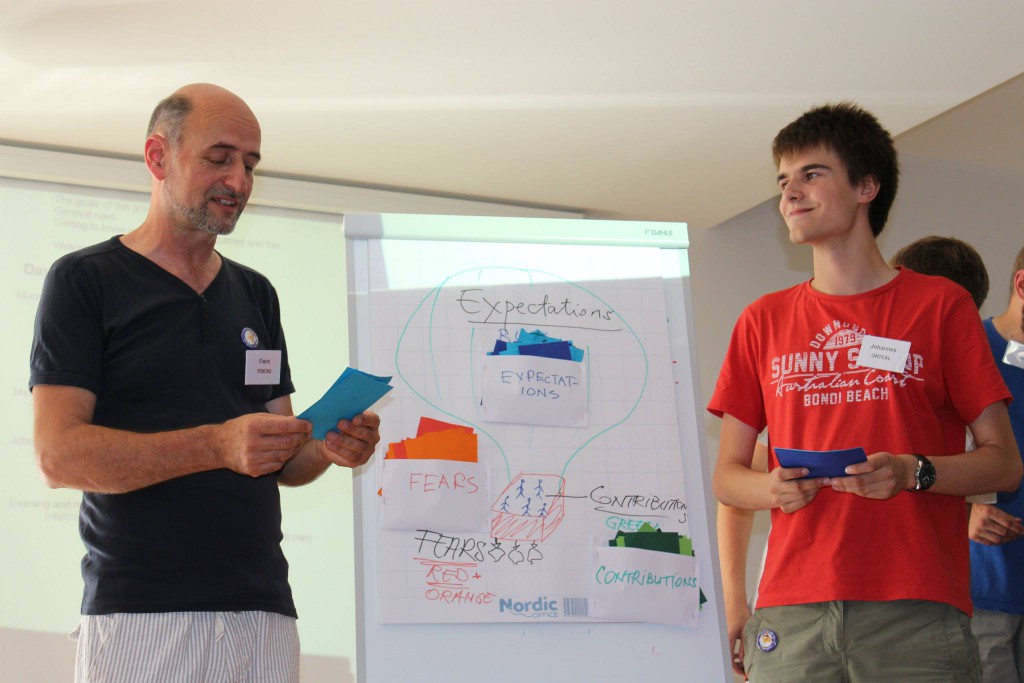
At the beginning of the week, all participants were asked to introduce themselves, tell people of their personal situation in relation to licenses etc and to set out their fears, expectations, and any ideas or special skills they can offer during the course of the event.  Once completed, these were read out and it appeared many of the participants were experiencing similar fears, with most of those surrounding the social aspect of the week as well as skills within the hobby and potential language barriers.  Many youngsters’ expectations were also alike, especially in relation to expanding their knowledge of the hobby in general, or learning extra skills in operating on the air.  They anticipated that the practical skills learned throughout the event would assist them personally in their own home environment.

A lot of youngsters set out the skills they would be happy to assist other people with, eg good operating, motivation etc and the purpose of this was to assist other participants who may require a friendly, helping hand for all sorts of different reasons.

Visit to TU Eindhoven

By | YOTA Belgium & The Netherlands 2012 | No Comments

One of the days we went with a bus to Holland, to visit the Technical University of Eindhoven. The radio amateurs, also known as PI4TUE, made an interesting program. In the morning we were received all together and the day was introduced by Martin PA3DSC.

The group were divided in three smaller groups. All groups were visiting separate different rooms with other speakers. One of the subjects was visiting the radio station which is located very high on the 13th floor of the building with a beautiful view over the city of Eindhoven. We had a small tour through the station of PI4TUE. Besides contesting from this location here is much more located. Like PI4AA, which broadcast every month on HF and VHF radio related subjects. Or the system of PSK mail where we also had a lecture about.

One of the other very interesting lectures where about Satellites, by Bertus PE1KUH. He told us about all kind of satellites, it didn’t happen that much to get everyone quiet for such a long time.

Rein PA0R told us about PSK Mail. It is fascinating to send for example e-mails without the use of internet but with the use of radio waves. More information about that is on http://www.pskmail.org/

In the afternoon we went with the whole group to the EMC lab, had a tour over there which finished with a “show” of a Tesla Transformator.

[wpgallery3 AlbumId=1588]

Lisa Leenders
PA2LS

Arduino Workshop

By | YOTA Belgium & The Netherlands 2012

One of the upcoming trends in electronics is Arduino. You can control a lot with an Arduino shield or chip. Arduino can sense the environment by receiving input from a variety of sensors and can affect its surroundings.  Examples are blinking lights, controlling LCD screens, programming a robot or controlling your antenna rotator. This is still a bit from everything which is possible.

Arduino is an open-source electronics prototyping platform based on flexible, easy-to-use hardware and software. It’s intended for artists, designers, hobbyists and anyone interested in creating interactive objects or environments.

The group got in contact with this under the visit to ON7ERA and it was most appreciated!

All the youngsters did know the basics of electronics or more at the start of the workshop but Arduino was new for some of them. This workshop did focus on the beginning of programming and controlling components.

In the beginning we had a short lecture where the content was explained. Soon we all received a kit and started building by ourselves based on a schematic given to us by the crew. The first goal was to make a blinking LED. After not that long, all the youngsters had made it and was eager to continue with more advance projects.

Quite a lot of us where enjoying building with Arduino so much that we continued making more codes during the week when we had our spare time. Even after Youngsters On The Air, back home, some made more advanced projects with Arduino and are even controlling amplifiers and antennas with it.

[wpgallery3 AlbumId=1549]

Foxhunting at ON7LR

By | YOTA Belgium & The Netherlands 2012

The YOTA group went to ON7LR which is also known as OT5A, the contest station. The area is an old stronghold place where there were a couple of massive castles surrounded by a big wall. Operating places were everywhere around the area let alone antennas! Some of them were on the top of the hill so they didn’t need high towers.

We had one YOTA station on the air from OT5A and it became quite popular. All the time one of us youngsters had a good pile-up to run!

In the afternoon we had an opportunity to find hidden foxes in surrounding forest. We managed to find them all in small groups which is of course more efficient as you have more eyes looking around! Some foxes were hidden in difficult places so we couldn’t find them easily, but nothing is impossible when fox receiver is in your hands. Every checkpoint transmitted one minute of different call sign in Morse code so it was possible to discern foxes from another.

During the sunset we had barbecued meal straight from the grill. That definitely was a nice way to end the day!

[wpgallery3 AlbumId=1553]